


October 14, 2026

Ruaha National Park is the largest national park in Tanzania and one of the great lion landscapes left on earth, and the remarkable thing is that […]

Let our local experts help you find a safari holiday package that suits you. Start the conversation with an email. Or WhatsApp +1 (313) 266-2701
Uganda’s smallest national park sits in the far south-west, wedged into a corner where three countries meet, beneath three volcanoes that look like something a child would draw. Mgahinga Gorilla National Park covers barely thirty-four square kilometres. You could drive across it in an afternoon. And yet the travellers who make it here almost always leave saying the same thing, which is that they wish they had given it longer.
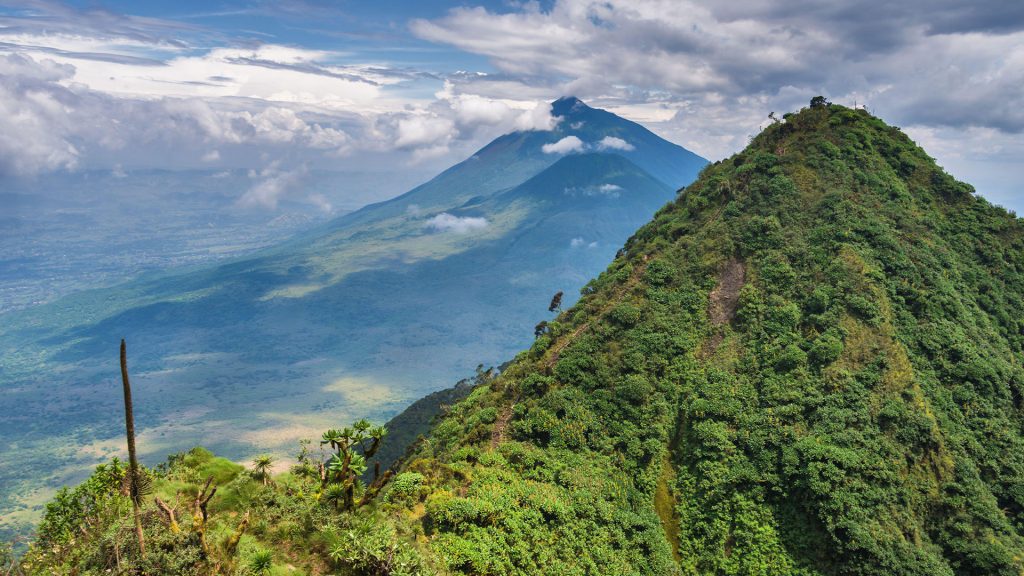
Three volcanoes, three countries The park is the Ugandan slice of the Virunga chain, that spine of volcanoes shared between Uganda, Rwanda and the Democratic Republic of Congo. Three of them stand within or on the edge of Mgahinga: Muhabura, Gahinga and Sabyinyo, the last of which is a jagged old cone whose name means the teeth of the man who bit the sky, which is exactly what it looks like.
Sabyinyo has a peculiar distinction. Climb it, and at the summit you can stand with one foot in Uganda, one in Rwanda and one, near enough, in Congo. Few places on earth let you be in three countries at once while catching your breath at nearly four thousand metres.
The setting is the first thing that gets people. Bamboo and montane forest run up the volcanic slopes, the air is cool and thin, and mist moves through constantly, so the mountains appear and disappear like something being remembered.
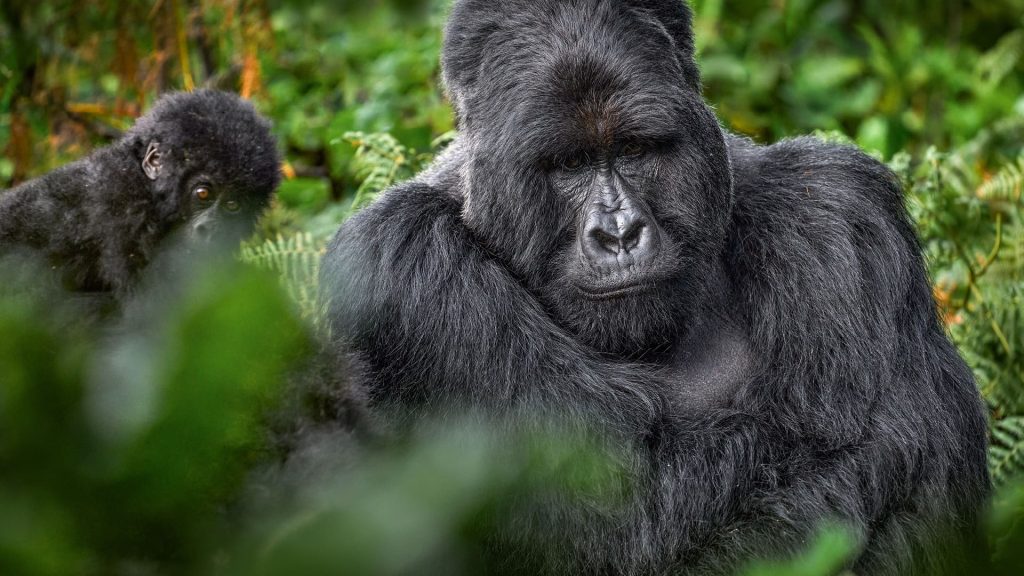
Mgahinga has one habituated gorilla family, called Nyakagezi, and its story is part of the park’s charm. For years the group wandered across the border into Rwanda and Congo, so a permit here was something of a gamble. In more recent years they have settled and become largely resident, which makes gorilla trekking in Mgahinga a genuine proposition rather than a hopeful one.
Trekking here feels different from Bwindi. The forest is more open, the bamboo lets light through, and the volcanic slopes give you long views out over the plains as you climb. It is still demanding, still steep, still muddy when the rains come, but it is a different kind of walk in a different kind of forest. And because so few travellers come here, you are unlikely to meet another group all day. If you want to read how the trek itself unfolds, our gorilla trekking guides cover the briefing, the rules and the hour with the family in detail.
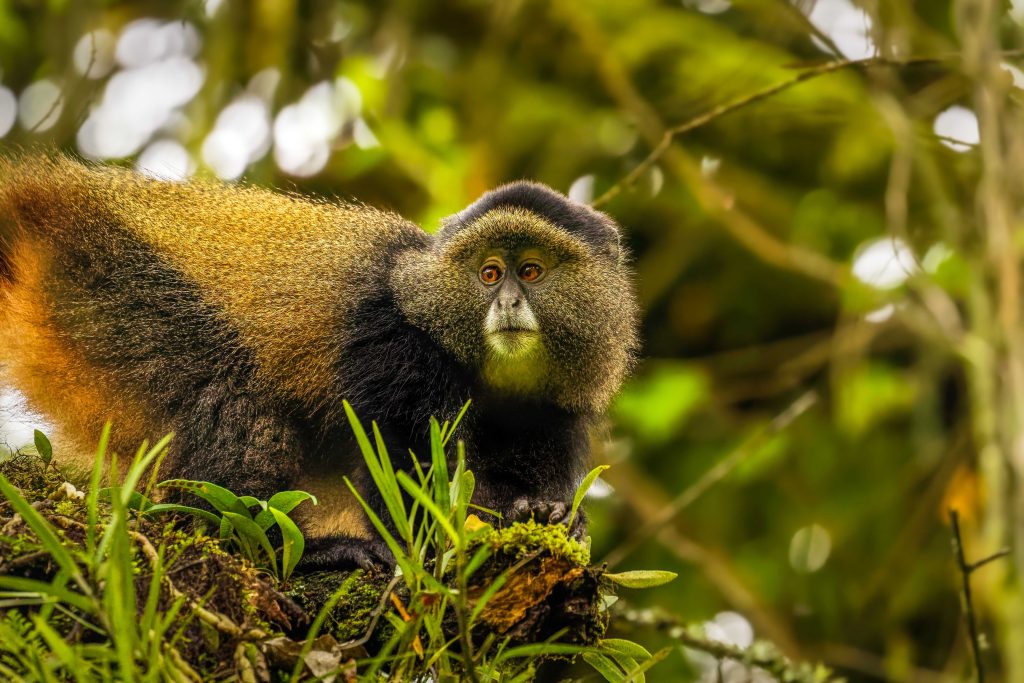
Here is Mgahinga’s other headline, and for some visitors it is the better one. The bamboo zone on the volcanic slopes is home to troops of golden monkeys, a bright, restless, endangered primate found only in this small stretch of the Virungas and the neighbouring forests.
Tracking them is a completely different experience from the gorillas. Where a gorilla family sits and eats and tolerates you with enormous calm, golden monkeys are motion itself: leaping through bamboo, chattering, dropping stems, flashing gold and chestnut through the green. They are hard to photograph and impossible not to enjoy. A morning with the gorillas and an afternoon with the golden monkeys makes for one of the best primate days available anywhere in Africa.
Mgahinga also holds one of the most affecting cultural experiences in Uganda, and it deserves to be understood properly rather than treated as an add-on.
The Batwa, a forest people, lived in these mountains for thousands of years as hunter-gatherers before conservation policy moved them out when the park was created. The Batwa Trail is led by Batwa guides through the forest that was once their home, showing how they hunted, which plants they used, how they made fire and shelter, ending in a cave that was once a communal home and is now filled with singing.
It is beautiful and it is uncomfortable, because it makes plain that the protection of these forests came at a human cost that is still being lived with. Visitors who go expecting light entertainment are usually quiet afterwards. It is, in my view, one of the most honest cultural experiences in the country, and the income goes directly to a community that has very little.
The obvious question is why a park this rich sees so few visitors, and the answer is simply Bwindi. Mgahinga sits a couple of hours from the far more famous forest, has one gorilla family to Bwindi’s many, and gets skipped by itineraries built around the headline name.
That is Mgahinga’s loss and your gain. Fewer permits means fewer people, and fewer people means a trek where the forest belongs to you. The park is also easy to combine, sitting close to the Rwandan border, so it slots neatly into journeys that cross between the two countries or continue on through south-western Uganda. You can see how it fits within our wider Uganda itineraries.
There is a practical note worth adding. Because there is only one habituated family, permits are genuinely limited, more so than anywhere else in Uganda. The Uganda Wildlife Authority issues a small number each day, and they go early in high season.
The mistake people make with Mgahinga is treating it as a half-day stop between other places. Two days transforms it. One for the gorillas, one for the golden monkeys and the Batwa Trail, or for the climb up Sabyinyo or Gahinga if your legs are willing. Add a night in a lodge on the park’s edge, with the volcanoes filling the window and woodsmoke in the evening air, and the smallest park in Uganda starts to feel like the most complete.
There is a particular pleasure in places that are overlooked. You arrive with modest expectations and leave slightly indignant on their behalf, wondering why nobody told you. Mgahinga does this to almost everyone who visits. It is thirty-four square kilometres of volcano, bamboo, gorillas, golden monkeys and a history that will stay with you longer than the photographs, and it asks only that you give it more than an afternoon.
If a quieter trek and a fuller few days in the Virungas sound like your kind of travelling, tell us and we will build Mgahinga in properly rather than squeezing it around the edges.

The authors are a team of safari consultants from East Africa. Having been born and raised there and with over twenty years of experience in planning and managing safari trips, they are well-versed in the topics they discuss in this blog.
More about us >


